
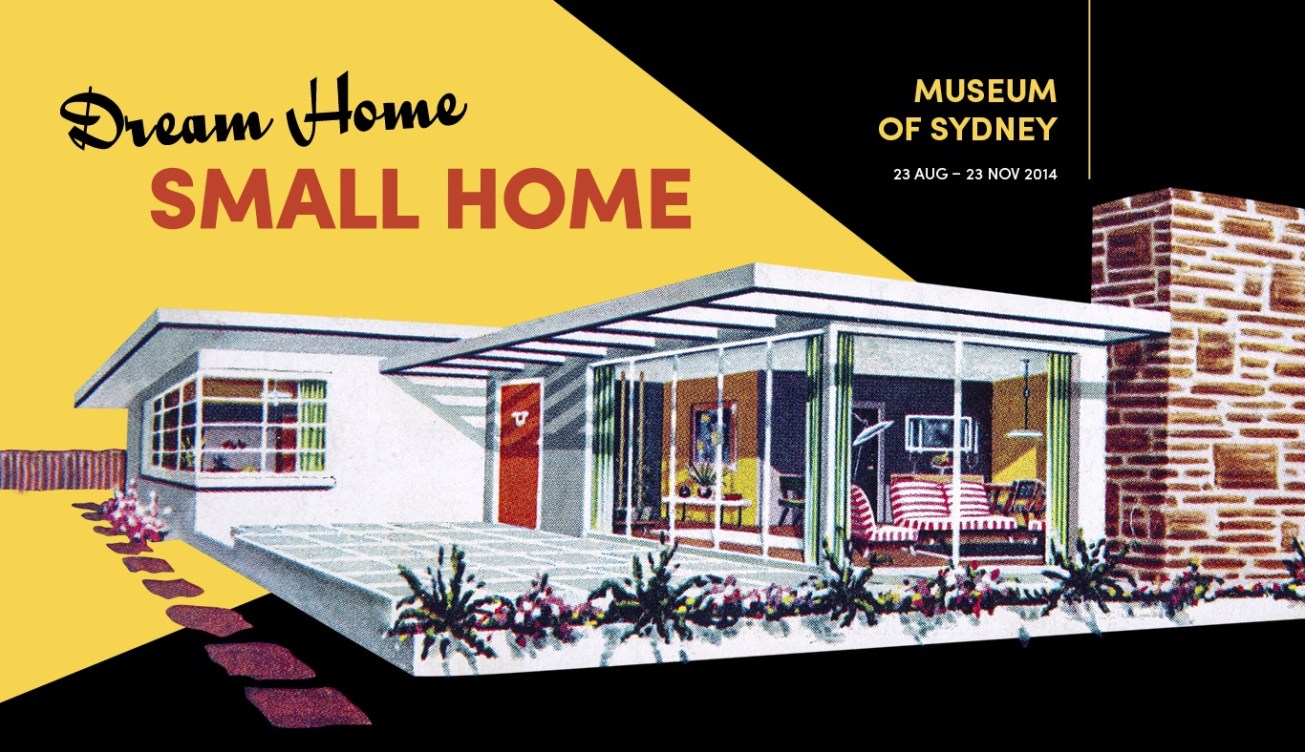
Post WW2 home interiors in Australia were featured prominently in women’s magazines and newspapers, alongside houses designed by architects. Small plans were made available via the main representative architectural bodies (e.g RAIA – Royal Institute of Architecture) Victoria and NSW. Plans were also sold by department stores like the Grace Bros and Anthony Hordern’s even had demonstration homes erected inside their large stores.
The most successful of the small plan services was in Victoria, and led by architect and writer Robin Boyd. NSW had a service in the 1920s but it closed, and later re-opened with post-war demand and pressure from the newspapers. Mass migration and new technology all helped kick off the post-war boom in building and interiors, with Australians possessing a desire to create something new for themselves, and something that would respond to our unique landscape and climate.
With many previous homes built in the image of English or European cottages, apartments and row houses, one of the biggest changes was to kitchens. Kitchens were often internal rooms and cooking was not on display. Plus, houses faced the wrong aspect and spaces were segregated – a reflection of a stratified society where more hierarchies existed and women’s work in the home was less appreciated. Ventilation also wasn’t always prioritised and heating was provided by fireplaces, while cooling was reliant on fans or a backyard sprinkler game if necessary. Generally, most people could not yet afford swimming pools.
The NSW Small Homes Service in 1953 preceded Sun-Line Homes in 1958 – a forward thinking project home builder which later led to the founding of Pettit & Sevitt in 1961. The long, low lines of the now-iconic Beachcomber by Nino Sydney for Lendlease Homes also arrived around 1961, as well a number of house ‘formats’ you might recognise around Sydney and beyond. Perhaps you own such a house from the many house plans available at the time? Cottages, flat roofers, bungalows, courtyard houses and fibro houses were just some of the small homes available to Australians before the 1960s, in addition to architect-designed houses for those in the professional pay grade.
I always encourage people to find out a bit about their house if they can, and definitely to do so before any renovation. I’ve been emailed and approached about everything from doorhandles to timber finishes, and truthfully, it’s impossible to know what approach to take if you don’t consider the DNA of your home. It’s not necessary to live in a museum or an ode to the 50s, in fact – it’s impractical for many people to emulate that time as the objects, fabrics and the lifestyle is vastly different to today. But, painting everything white may not be your best solution either. So, find out everything you can and start there.
Look at your site, talk to a good designer or architect if you’re having alterations and additions, consider improvements that are sensitive to the inherent style you have, even if you’re adding something contemporary. If you have a cottage, don’t try to make it a Split Level. If you have a Split Level, don’t try to make it a ‘Hampton’s house’ …whatever that means (we do have our own vernacular of this style and it’s basically ‘a Palm Beach house’). We do have our own beaches and there are coastal styles found in the northern beaches, Queensland tropics and Western Australian coast lines will offer hints: many were weatherboard on stone or brick foundations. So, find the equivalent of what you have inherited rather than trying to turn it into something that it is not – that’s just my opinion. But, it means you avoid destroying the architecture you’ve bought and you’ll save a lot of time and money. It’s always mystifying as to why the ‘Hamptons’ name and trend has taken hold here as we also have equivalent furniture styles and makers.
I also know some people own ‘Sydney School’ homes – a loosely named modernist architectural style that came along in the 1960s and 70s, characterised by exposed clinker brick, expressed beams and timber panelling. Most people who buy, live in, or grew up in these lovely warm spaces really understand their appeal. They are homes which often commune with nature, use natural materials, have good aspects and open plan outlooks to the bush.
New owners sometimes buy them and simply don’t like the brick or don’t like certain parts of the house. No home is perfect and it’s true to say that layout sometimes needs an update in order to be suitable for the 21st century. Exposed clinker brick has its merits but it is best to try to understand it in the context of your house and site, before rendering it to oblivion (RIP). Apart from the expense, you’ll be locking yourself into a lifetime of re-rendering and painting once coating the brick.
Likewise, there are ways of gently improving features without painting over everything. Greige might be fine if your house is all straight lines, minimalist and tonal in greys, and could be fantastic for apartments… but using it to erase natural timbers, beams and floors can cause a regret that is too late, and too expensive to undo.
Read about The Small Homes Service
Images: (c) Museum of Sydney

Courtesy Museums Victoria
https://collections.museumsvictoria.com.au/items/2095627
Here’s a great article about the Small Homes Service by Dr Noni Boyd.

 Sydney House.