

Spending time in our original P&S Lowline have given us some of the best family years of our lives. It was comfortable, small enough to heat or cool with the air-conditioning that must have been installed in the 1990s, and had all the essentials: a carport, big yard, a main bathroom and an ensuite and kitchen which the previous owner had renovated also in the 1990s to a respectable ‘cream’ colour. We elected to live in the house for at least 5 years before deciding how to improve it. We slowly fell more in love with this feeling of ‘being home’ that it gave us. But then the kids were heading to teenage-hood and we could barely have a sleep-over or friends over (the bedrooms are a tiny 2.6m x3m) and playroom – what is that? It was tricky to schedule a luncheon with family if it threatened to rain (a minimum of 12 people for us and no deck or overhead cover) and our initial pleasure at purging all our ‘stuff’ due to lack of storage was turning into an impossible regime to continue over time.
Of course, many P&S homes were built to bigger sizes and with bigger bedrooms – it depended on the budget. And many had courtyards and wonderful landscaping from the outset – ours had no usable courtyard and a row of bricks as the back step for about 50+ years. Our original owner had 3 grown kids by the time she and her husband built the house in 1964. So, it really was sized for them as a couple and it was a miracle it had 3 bedrooms in that sense.
A carport also proved problematic on the north shore. One year my daughter and I were driving and discovered an infestation of huntsmen spiders due to the open carport being easy access for bugs from all the nearby tall trees. A nest had made its way to the car and bam! As soon as the hot weather came, it hatched. What a moment! Thousands of huntsmen scattered across the windscreen in an instant, much screaming occurred until we pulled over and had to whack as many as we could with a rolled up newspaper. When we got home, a full spray of and understanding the car was needed. The risk-of-accident emergency also made me cast a thought to the dream of a simple, clean, closed garage! All up, our 115 sqm home was simply much smaller than most.
So, we love our P&S even for its quirks, and there are other quirks we noticed which were ones that could only be addressed via a renovation. For example:
- Most P&S’s had no insulation in the walls or roof whatsoever – our Western side where one of the bedrooms is, would get pummelled by heat and cold and eventually developed very bad mould…more on mould later
- Most of the fascia over the years had been adhoc replaced with pine, which by 2016 had well and truly rotted
- The beautiful Oregon beams leading to the car port was rotted but thankfully the internal Oregon is okay!
- Our bedrooms all face north, …just getting dressed to go out in summer results in profuse sweating whereas these days family, kitchen and entertaining areas tend to face to the north
- The laundry had no fancy tiles…oh how wonderful that would have been. It was carpet on concrete and a deadly dryer and makeshift sink was promptly replaced by proper cabinets and appliances.
- Before moving in, the 50+ year berber carpet (while lovely) had to go. It has 50+ year pet stains in it too…I’m sure carpet isn’t meant to be kept in that state
- Bless her, our original owner was a chain smoker – no amount of scrubbing would remove the yellow staining throughout the house…so we gave every wall a coat of ‘Natural White’ before moving in 2011. It made the lovely floor-to-ceiling pale eucalyptus internal doors look positively new!
Once we went through our design and DA process, it was clear that the new additions to the house would be very energy efficient…to the point where the old P&S building would be insufficient. BASIX these days is nothing like the codes of 1964, and indeed environmental standards didn’t really exist.
To get the P&S functioning properly for 2017 it would need (along with the new additions):
- Insulated walls and ceilings
- Insulated roofing and building wrap (to prevent condensation)
- Removing the asbestos in the laundry (a stage still to come) in order to insulate everything there
- New plastering after our massive October roof flood 😦
- Low E glass for any and all doors and windows facing north and north-west (farewell old windows)
- The benefit of solar panels, the next step when the building is well and truly done
- The benefit of rain water tanks, also coming…
In addition to this, we had to fix a couple of faults. A P&S house with faults? Noooooo! Well in our case it was a surprise discovery that the Oregon beam running along the entire western wall and supporting the ceiling and roof, was unsealed. My husband climbed up on a ladder outside one day before the build started and discovered the beam had been placed on the brick wall, slightly askew. The result is, the brick veneer cavity was never closed off to the elements (not to mention rodents). There was a 10-20mm gap at the top of the brick wall where the beam should have been placed straight over it, so we now had the real cause of the mould gathering in our daughter’s bedroom …not to mention the extreme heat and damp which would occur in alternating seasons.
Once we found this, we temporarily blocked the gap with some old bricks (!) knowing that once the build started, we would be able to rectify it properly. Hooray!
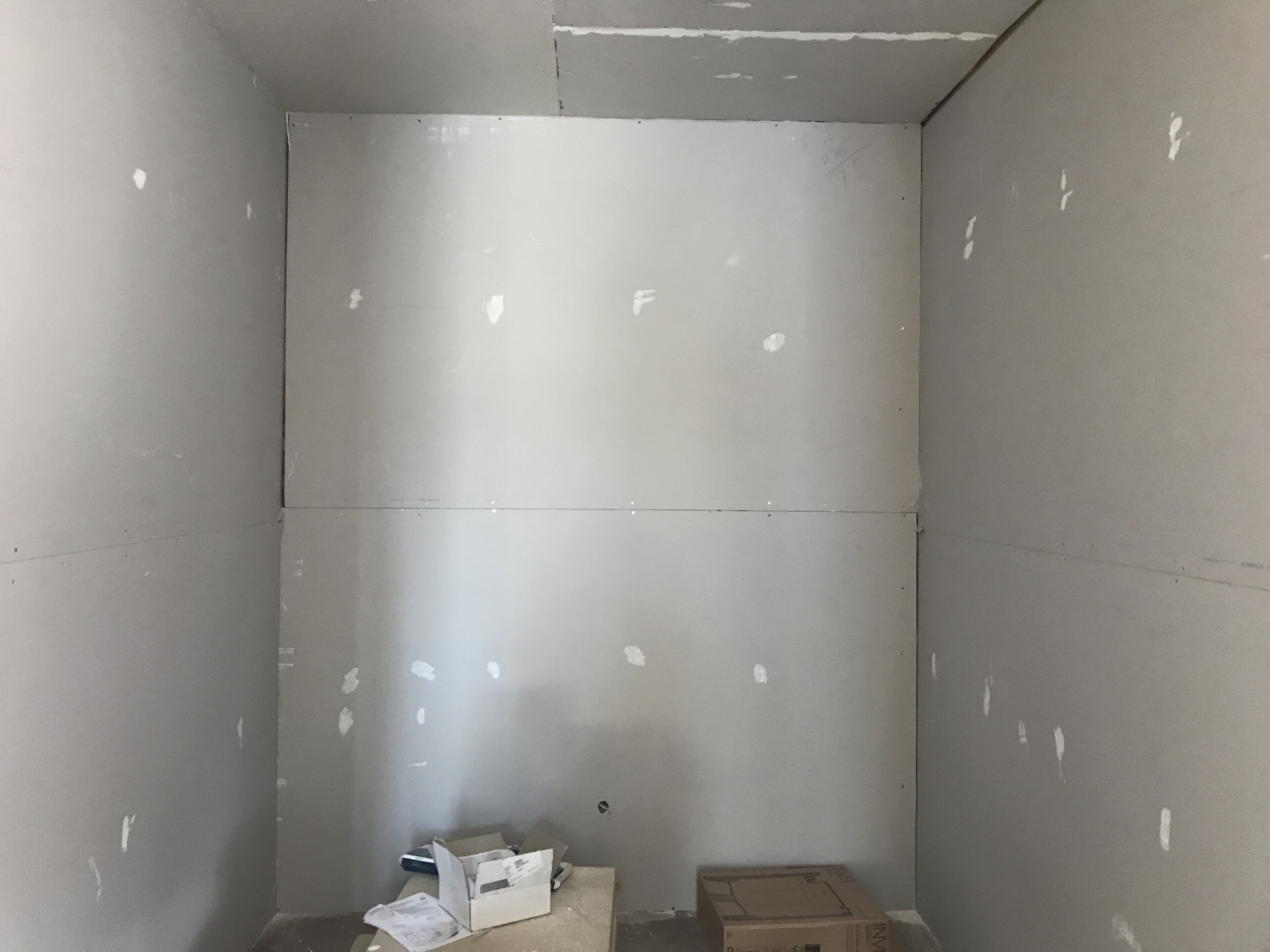
So here we are at insulation and plastering stage of the addition, which has taken place during August.
We are almost at the stage of being able to move out of the P&S bedrooms so that the old nicotine-stained walls can be removed, insulated and re-skinned. This includes the original 34sqm living/dining room which will connect through to the new kitchen. The old/1990s kitchen will revert to a room and whole Lowline bedroom area will become the much needed quiet zone. During this time, the floor-to-ceiling doors will be saved so they can be re-installed; the Oregon beams will remain and will get the benefit of eventually being re-oiled in the Japanese black stain. Getting there!
Note – the new additions don’t have the Oregon beams as obtaining these for structural use is pretty expensive today, but they are throughout the original space and will remain so.

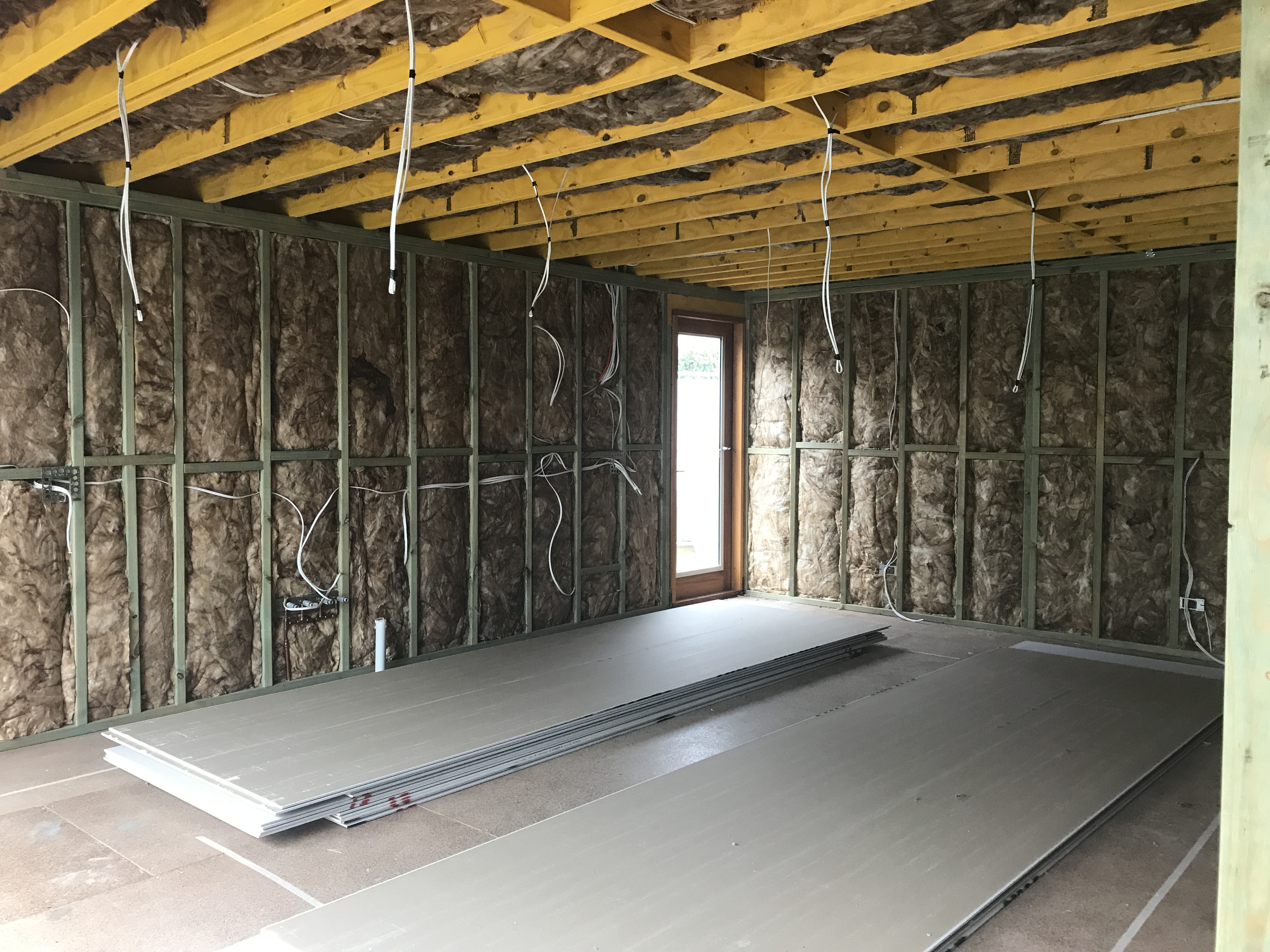
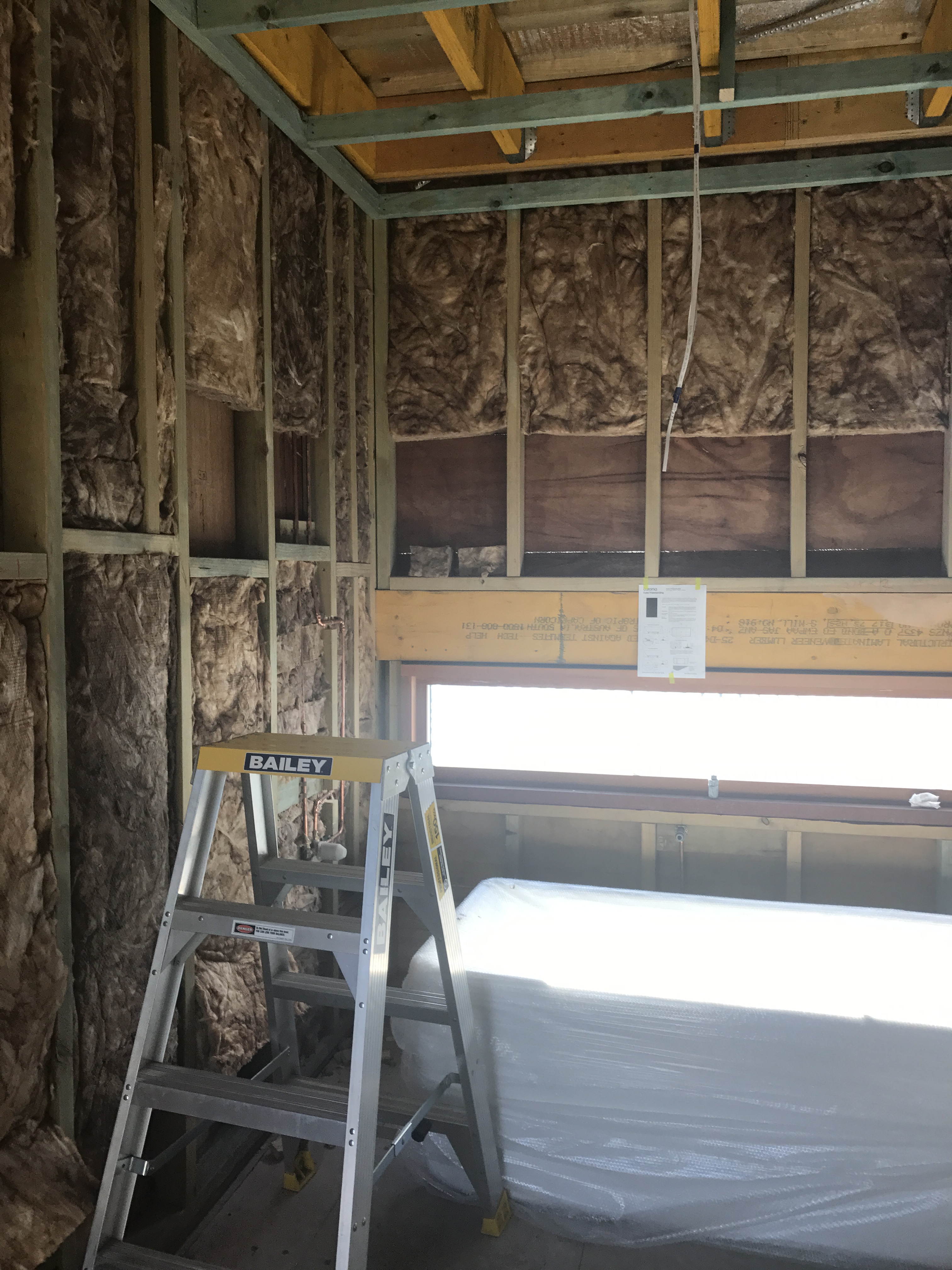
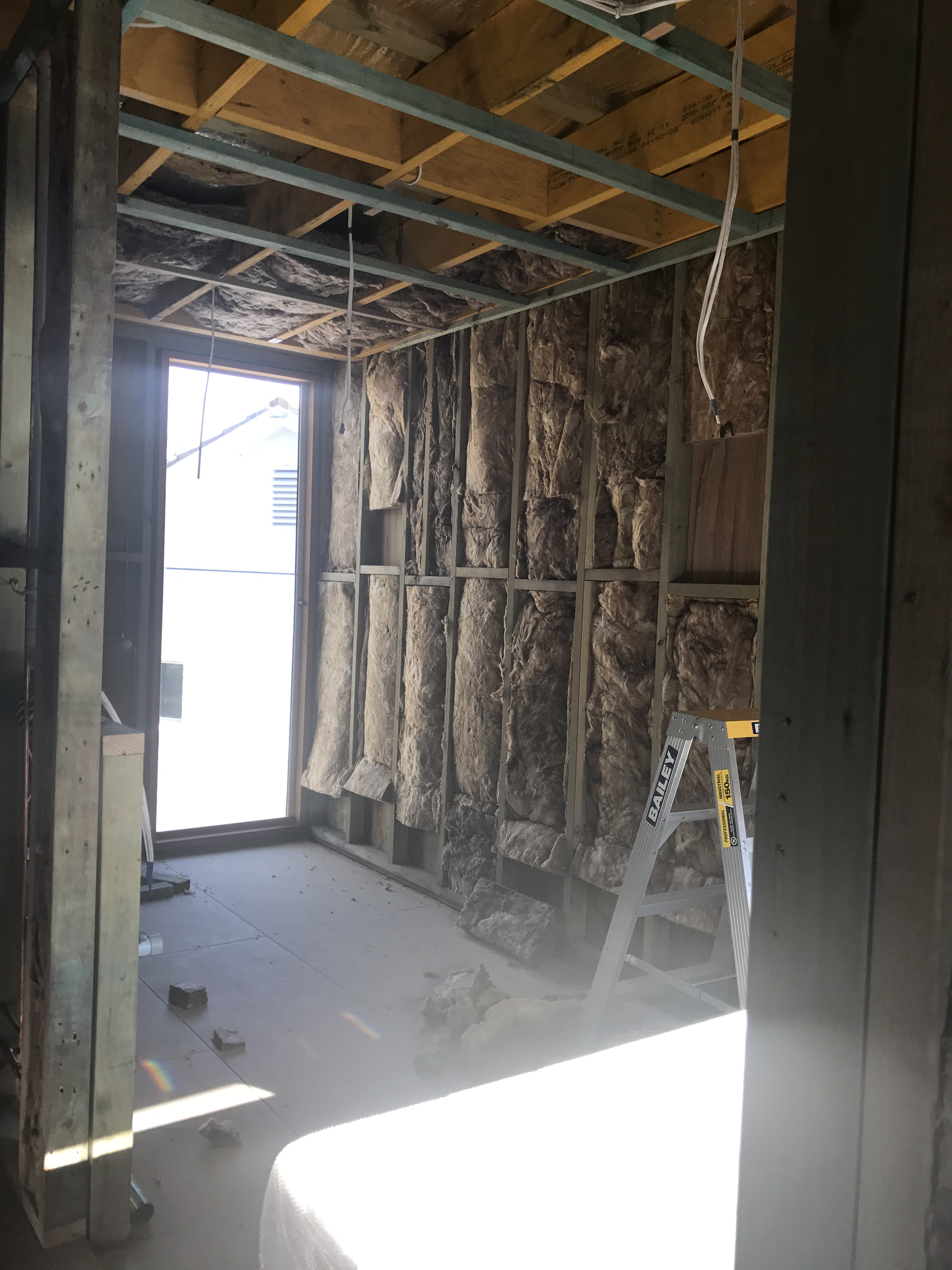

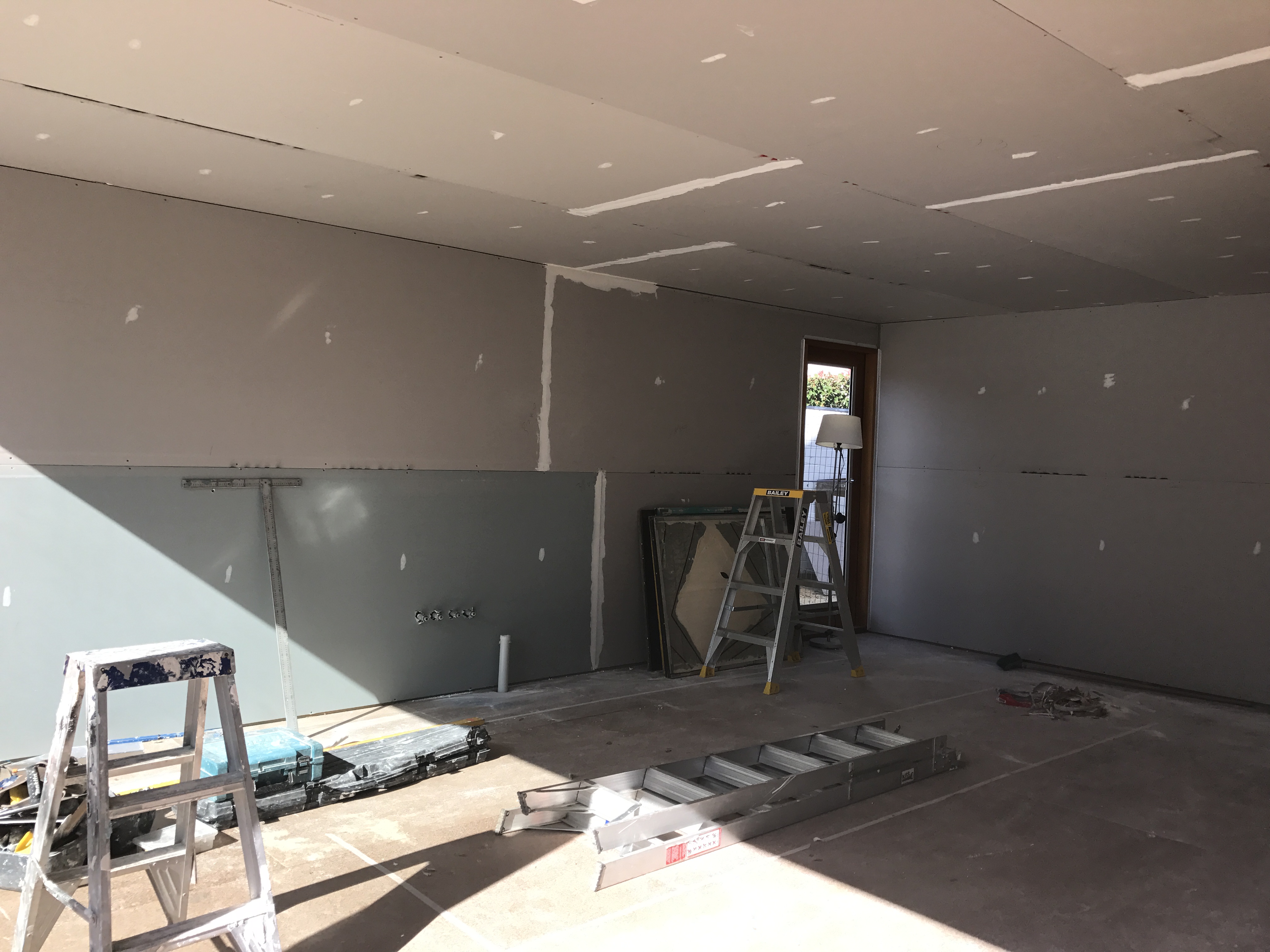
The new kitchen area being plastered

The upstairs family room with reflections from the pool today

The stairwell, once the exterior Eastern wall

The garage plastering, leading out to the rear. Boundary walls to be painted white in keeping with the original house

Looking down to the peek-a-boo window from the master bedroom stairs. A small walled garden will replace the old kitchen courtyard that had an overgrown Monstereo plant terrorising the house foundations

Arriving up the master bedroom stairs to the landing, with a view out. The external brick in this area was also continued from the original P&S up into the new volume. Brick will be white

Master bedroom with P&S style windows and all

View from the master bedroom to the rear
A modest walk-in wardrobe for husband and I was included in the master bedroom and should be a relief for storage!

The master ensuite with plastering just installed, sanding and setting to come

Looking at the bath tub’s spot and another peek-a-boo window. Not very glamorous with all the building debris!
 Sydney House.
Thank you!
Just wondering if you happen to know whether other Pettit & Sevitt owners have hydronic underfloor heating or underfloor air conditioning? Interested to know as I am getting quotes and both are very expensive and don’t want to make a mistake.
Much thanks
Jenny Johnston
Hi @kimandjenny, I do know that some P&S owners had underfloor air conditioning installed back in the day, with air vents positioned coming up through the floor boards. Some of those houses might have had air con systems replaced now but have kept the underfloor position. It’s certainly possible if your house has the underfloor space available and it’s neat, compared to units on the walls. For hydronic underfloor heating, it seems this is likely only possible on a concrete slab or in the bathrooms if you’re having them re-done, since they’d be able to lay it after the concrete screed and before the tiles. Definitely get quotes. There is also a very good Facebook group that may be of assistance in terms of which of these options are most efficient to run (in terms of cost and power): https://www.facebook.com/groups/MyEfficientElectricHome
Thank you so much for your reply. Very helpful to know other P&S owners have retrofitted underfloor air con. Thanks also for Facebook contact.
Much appreciated
Jenny Johnston 😁
Hi there
I own a Lowline Pettit & Sevitt in St Ives with a flat roof. Just wondering when you renovated your Pettit & Sevitt what did you find was the best way to provide heating? I am finding house quite cold and am wondering if underfloor ducted heating is the way to go or if there’s another option hopefully cheaper and quieter?
Any suggestions gratefully appreciated.
Much thanks
Jenny Johnston
St Ives NSW
Hi Jenny, thanks for your question. When we replaced our Lowline roof, we increased the R rating on the roof insulation which helped a lot. However, we were also able to insulate the cavity walls (which were replaced with new Giprock) and I think this really helps too. The other tip is to look at all your windows and see if you can seal the gaps, there is a tape and other methods for this. Even better if you eventually re-fit or replace some windows. We didn’t use underfloor heating as our house was a bit too low to the ground and we couldn’t get the required equipment under there, but if you can: I am told this is a reasonably good solution and provides a comfortable space for the deep winter months like July. We know a few owners of Split Levels who have underfloor heating and they really love it. Hope this helps!